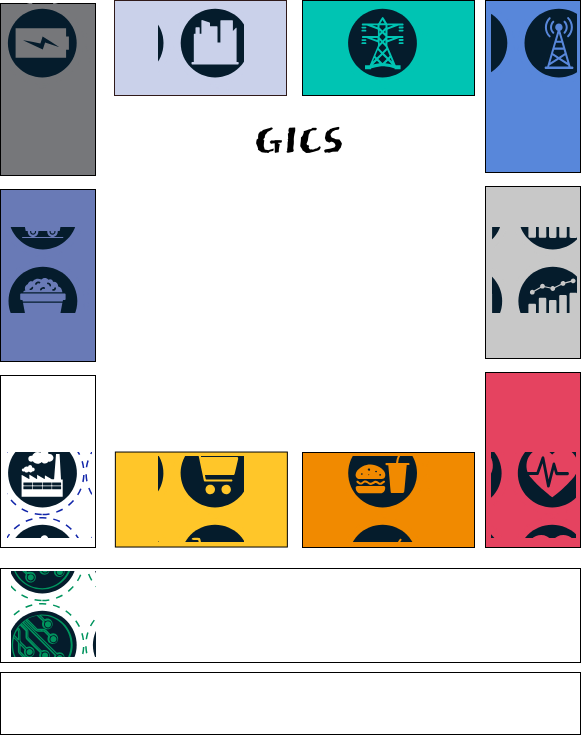
GICS Micro-& Nano-Sectors (Thematic Portfolios)
Who are the relevant players behind lidar technology? Where could the next big growth driver be hiding in the robotics environment? Which companies are still largely shaped by their founders? And which names are showing the first signs of increased market tension before they receive widespread attention? Answers to such questions rarely emerge at the level of large sectors. They can be found where markets are broken down more finely: in thematic and curated portfolios that specifically search for commonalities, patterns and anomalies (nano perspective).
GICS MicroSectors starts at a level above the aforementioned thematic approaches. The focus is on small, clearly defined thematic units within markets that are meaningful in their own right, but are often lost in traditional sector logics. Microsectors do not describe new industries, but rather precise sections of existing markets - where technology, business models and attention are visibly concentrated. Typically, these are areas in which there is a cyclical, seasonal or news-driven increased need for information and analysis. These topics often mark transitional phases in which specialized market segments develop into broader trend areas. This development is usually accompanied by increasing public awareness, which is reflected both in the intensity of reporting and in the price movements of listed business models. GICS MicroSectors makes precisely these early consolidations visible and thus creates a focused level of classification between higher-level market structures and individual company analyses.
In order to limit the large number of possible MicroSectors to a manageable and relevant level, GICS MicroSectors follows a clear selection principle. Topics are considered where there is an overlap between a specific need for information, increased news density and recurring attention within the international investor and trading community. In addition, data-based evaluations and patterns from public communication and discussion in social media are incorporated. GICS MicroSectors thus creates a precise level of observation between the broad market structure and individual stock analysis. The focus is not on forecasts, but on visibility: on topics that start small, but have enough substance to be perceived as an independent market component.

Within GICS Eleven, the relationship between TIER 1 (CORE), TIER 2 (TREND) and TIER 3 (MICRO) is not conceived as a break, but as a logical continuation within a finely graduated relationship and dependency structure. The tiers build on each other and complement each other instead of functioning separately. TIER 1 (CORE) forms the overarching framework. It serves to structurally classify companies, business models and value chains and provides orientation at a meta-level. TIER 2 (TREND) and TIER 3 (MICRO) start where thematic consolidations, accelerated developments or focused priorities emerge within this framework. Market dynamics and changing information situations can lead to overlaps that make clear categorization difficult or deliberately leave it open. However, this is not a shortcoming, but a conceptual feature. The levels are always related to each other and allow different perspectives on the same market context.
Whether a perspective is perceived as particularly relevant, purely informative or subjectively significant is ultimately at the discretion of the user. GICS Eleven therefore does not see itself as a conclusive authority, but rather as a structured orientation framework. A claim to completeness or interpretative sovereignty is expressly not associated with this
This symbiosis is particularly evident in the example of the Feingold Research information portal. The Materials meta-sector forms the overarching frame of reference: All companies assigned to the sector are fully covered and linked to the relevant news. This creates a complete sectoral sounding board that covers the breadth of the market. At the same time, trend sectors are derived from this core as independent info streams. These no longer follow complete coverage, but rather a focus on content. The range deliberately extends from meta to micro: from Materials as a superordinate sector, to Mining as a functional and operational consolidation, to Rare Earths as a thematically highly specific section within the same value chain. The dividing line is not in the object - some of the companies are the same - but in the perspective.
Tier 1 (Core) answers the question: Where does a company structurally belong?
Tier 2 (Trending) answers the question: Why is a part of this sector currently in focus?
Trend sectors are therefore not created by new classifications, but by thematic weighting, news intensity and market attention. They form dynamic observation areas in which developments emerge earlier and more concentrated than in the broad core.
Like GICS Alpha or GICS IPO, these trend sectors act as curated layers of information: They filter out those segments from the core that are currently characterized by technological, geopolitical or demand-side impulses. This creates direct added value for journalists, editorial teams and analysts: instead of having to sift through the entire meta-sector, the system provides thematically precise information streams that pre-select relevance.
As a result, GICS Eleven thus forms a multidimensional classification system: The core provides structure and completeness, tier 2 for focus and topicality, tier 3 for analytical depth. Trend sectors are not a counter-design to the meta-sector - they are its moving projection.
GICS Entertainment is a trend area within GICS Eleven and focuses on companies that offer experiences, leisure and entertainment in physical or media form. The focus is on operators of hotels and resorts, organizers of major events, listed soccer clubs and international entertainment brands such as MGM Grand. Cruise companies such as Carnival can also be assigned to this sector. The spectrum is rounded off by film studios and streaming providers such as Netflix and Paramount. In contrast to GICS Betting, which is heavily geared towards digital platforms, betting and interactive gaming formats, GICS Entertainment focuses on the experience itself. It is about places, events, content and formats that people consciously seek out or consume - be it on location, on stage, in the stadium or via traditional and new media channels. The market is characterized by major brands, high visibility and clear offer formats. Stationary experiences such as resorts, shows or sporting events are just as much a focus as media entertainment via films, series and streaming. Both worlds are increasingly intertwined, but remain different in their logic: while betting focuses primarily on participation and interaction, entertainment thrives on staging, reach and recognizability. GICS Entertainment bundles this diversity independently of individual industry labels. The focus is on companies that make entertainment scalable - via locations, formats or content - and thus occupy a permanent place in the everyday lives and leisure time of many people. It is precisely this breadth and visibility that makes the area an independent trend sector within GICS Eleven.
GICS Betting is a trend area within GICS Eleven and focuses on a market in which entertainment, technology and betting are increasingly converging. The spectrum ranges from traditional gambling and casino operators to online betting platforms, gaming formats and eSports environments. What used to be clearly separate has become much closer thanks to digitalization, streaming and mobile use. The trend is determined less by individual products than by changing usage habits. Interactive formats, real-time experiences and digital platforms have opened up new target groups and expanded existing offerings. At the same time, the market has become more professionalized: Operators are acting globally, content is being scaled and regulatory frameworks are creating new scope as well as clear boundaries. GICS Betting bundles this development independently of traditional industry classifications. The focus is on companies and platforms that monetize entertainment - be it through betting, games, tournaments or accompanying digital offerings. In this environment, new business models are emerging, existing providers are growing beyond their original core areas and the capital market is increasingly focusing on an area that is constantly reinventing itself.
GICS Sports is a trend area within GICS Eleven and focuses on markets that are directly or indirectly linked to sporting activity. The focus is not on a single sport, but on the entire environment that enables, accompanies or organizes movement, training and sporting activity. This includes traditional sports equipment suppliers as well as manufacturers of sports and functional clothing. Companies that develop wearables - for example to measure performance, exercise or health - are also part of this topic area. The spectrum is supplemented by providers from the fitness and training sector as well as organizers of sporting events with a wide reach. GICS Sports also includes companies that provide digital support for sporting activity. These include software and technology providers that develop apps and platforms, for example for training, performance analysis or preventative healthcare in connection with sport. The transition between physical activity and digital support is fluid. In contrast to GICS Lifestyle or GICS Entertainment, GICS Sports focuses on active participation. It is not about consumption or staging, but about movement, performance and physical activity - whether in competitive, popular or recreational sport. GICS Sports bundles the above-mentioned topics independently of classic industry classifications, without ultimately committing itself to a specific content. Users of this information channel will find an overview of companies and developments relating to sport, fitness and exercise, from equipment and technology to organization, digital support and, ultimately, sport as an experience and unifying element.
Thematic Portfolios (a/k/a Themefolios) represent an independent conceptual element. They have emerged from jointly developed ideas and are continuously developed further with input from the global investor community. At the same time, they serve as an interactive starting point for professional exchange within an international trading community. With now over 250 thematic focus portfolios (as at 01/2026), thematic portfolios condense market information into clearly defined micro and nano themes. The approach does not follow the logic of the greatest possible coverage, but rather targeted sharpening: trends, technologies, business models or governance patterns are made visible in the way they develop in detail and interlock with each other. GICS MicroSectors and the underlying Nano-Sectors level of analysis thus form finely resolved levels of analysis within the G11 General Industry Compass System. They supplement the overarching market structures with precise thematic depth of focus. The Curated Portfolios represent a further extension of this approach. They build on the Theme Portfolios and supplement them with an additional editorial and categorizing perspective. Anyone wishing to delve deeper into this concept will find the right entry point there
Due to the large number of individual topics, it has recently become possible to search specifically for companies and their thematic micro-clusters. If you want to delve deeper, hereyou can access the product and concept overview.