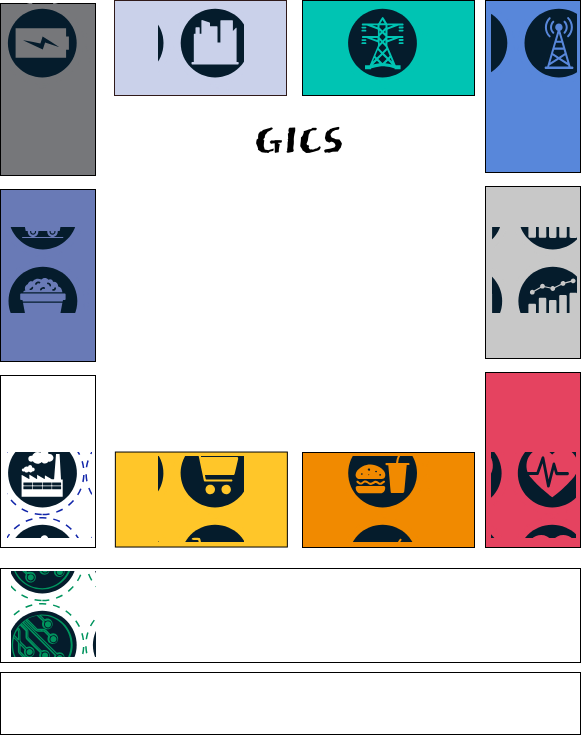
GICS Core

GICS Core is the top-level perspective within the Sector Intelligence of the G11 General Industry Compass System. This level is deliberately set at a distance and provides an overarching view of the central structures of the global economy.
The focus of GICS Core as the TIER 1 level of the G11 General Industry Compass System is on broadly defined economic sectors as stable organizational units. Instead of detailed subdivisions, the focus is on classifying economic activities into a few, sustainable categories that serve as a long-term frame of reference. The helicopter perspective of GICS Core opens up space for fundamental questions: How do weights shift between sectors? Which structures characterize entire sectors across economic cycles? And which sectoral dependencies only become visible from a distance?

The focus of GICS Core as the TIER 1 level of the G11 General Industry Compass System is on broadly defined economic sectors as stable classification units. Instead of detailed subdivisions, the aim is to classify economic activities into a few viable categories that serve as a long-term frame of reference.

The helicopter perspective of GICS Core opens up space for fundamental questions:

  • How do weights shift between sectors?
  • What structures shape entire industries across economic cycles?
  • And which sectoral dependencies only become visible from a distance?
EST.: I/MMXXV
The real estate sector brings together companies that deal with real estate as an economic resource. The focus is on the ownership, development, use and management of buildings and areas that serve as living space, working environments, infrastructure or investment properties. Real estate is an asset sector based on location and use. The companies grouped here create, manage or finance physical spaces in which economic and social activities take place. Real estate fulfills a dual function: it is both a basis for use and an investment. The sector is characterized by its long-term orientation. Investment decisions are capital-intensive, highly location-specific and have an impact over long periods of time. Demand arises from structural factors such as population development, urbanization, forms of work and economic use, rather than from short-term market movements. Real estate operates at the interface between business, financing and use. Rental income, value development, occupancy and management determine the economic logic, while regulatory requirements, the interest rate environment and financing conditions have a significant influence on income and valuation. The sector is also broadly based in terms of content. It ranges from residential and commercial properties through specialized properties to infrastructural and functional areas. Despite this diversity, all areas share a dependence on location quality, useful life and long-term planning. Within GICS Eleven, real estate forms the spatial frame of reference among the CORE sectors. It links real use with capital commitment and serves as a stable basis for topics relating to living, working, infrastructure and real estate-related value creation - regardless of economic or technological cycles.
EST.: XII/MMXXV

The Materials sector brings together companies that provide the physical raw materials from which economic activity is created in the first place. The focus is on raw materials, intermediate products and materials that are further processed and are at the beginning of numerous industrial, technological and consumer-related value chains. Materials is not an end market, but a foundation sector. The companies grouped here supply materials that are used in construction, industry, energy, technology, mobility, consumer goods and infrastructure. Their products are rarely visible to end customers, but are found almost everywhere. The Materials sector is characterized by its wide range of content. It ranges from basic, often raw material-related activities to highly specialized materials with clearly defined applications. The areas of application are correspondingly diverse: from structural building materials, metals and minerals to chemical products that are specifically tailored to certain industrial or technological requirements. What the companies in this sector have in common is their close connection to real production processes. Cost structures, energy use, transportation, economies of scale and regulatory framework conditions play a central role. At the same time, global demand cycles, geopolitical factors and technological developments have a direct impact on supply, pricing and investment decisions. Materials therefore plays a connecting role in the economic system. The sector is at the interface between natural resources, industrial processing and downstream industries. Changes in this area often have a time-delayed but profound impact on other sectors. Within GICS Eleven, Materials serves as a stable frame of reference for numerous specialized topics. It forms the content bracket for developments ranging from classic basic materials to highly developed material solutions - and thus creates the basis for further trend, micro and application perspectives.

EST.: XII/MMXXV

The Industrials sector brings together companies that enable, organize and implement economic activity. The focus is not on products for end consumption, but on services, systems and services that enable other sectors to operate in the first place. Industrials is therefore an implementation and operating sector. The companies grouped here plan, build, produce, transport, maintain or control - often in the background, but with a direct impact on the efficiency, scaling and stability of economic processes. Without Industrials, value creation remains theory. The sector is characterized by its functional breadth. It ranges from the manufacture of complex machinery and equipment to construction and engineering services through to professional services, logistics and transportation solutions. In addition, there are activities that ensure order, safety and organization - both physically and operationally. What these companies have in common is their operational proximity to the real economy. Projects, investment cycles, capacity utilization, maintenance and reliability play a central role. Decisions are often long-term in nature, highly capital-intensive and closely linked to economic developments, infrastructure requirements and global supply chains. Industrials acts as a link between planning and implementation. The sector translates demand, technological development and social requirements into functioning systems - from production facilities and transportation routes to supporting services in daily operations. Within GICS Eleven, Industrials forms a supporting regulatory framework for numerous specialized topics. It spans the spectrum from classic industry to modern service and infrastructure solutions to highly specialized applications - and thus creates a stable basis for in-depth trend, technology and application perspectives.

EST.: XII/MMXXV
The energy sector brings together companies that generate, process, store and supply energy. It forms the basis for almost every form of economic activity and is at the beginning of numerous industrial, technological and social processes. Energy is a supply and transformation sector. The companies grouped here develop natural resources, convert them into usable forms of energy and ensure that they are reliably delivered to where they are needed. The spectrum ranges from the extraction of raw materials, processing and transportation to the provision of various energy sources. The energy sector is characterized by its high systemic relevance. Energy is not an optional good, but a basic prerequisite for production, mobility, infrastructure and everyday consumption. Accordingly, changes in this area have an impact far beyond the sector - often with a time lag, but with major economic and political consequences. At the same time, the sector is characterized by complex dependencies. Global demand, geopolitical conditions, technological developments and regulatory requirements influence investments, cost structures and long-term strategies. Decisions in the energy sector are usually capital-intensive, long-term in nature and closely linked to national and international interests. Energy is also in a state of continuous change. While traditional forms of energy continue to play a key role, new technologies, alternative energy sources and changing usage models are gaining in importance. These developments are not linear, but run alongside each other and often with different time horizons. Within GICS Eleven, energy acts as a fundamental frame of reference for numerous specialized topics. The sector ranges from traditional supply structures to new forms of energy generation and use - and thus forms the basis for in-depth trend, transformation and application perspectives.
EST.: XII/MMXXV
The utilities sector brings together companies that are responsible for the reliable provision of basic supply services. The focus is not on generating demand, but on ensuring a continuous supply - regardless of economic cycles or short-term market movements. Utilities is a stability and infrastructure sector. The companies grouped here operate networks, plants and systems that supply households, companies and public facilities on a permanent basis. Their services are commonplace, often taken for granted - which is precisely why they are of central importance for the functioning of modern societies. The sector is characterized by its planning-oriented logic. Investments are long-term, regulated framework conditions play a major role and reliability clearly takes precedence over speed of growth. Decisions are aimed less at short-term efficiency gains than at security of supply, grid stability and sustainable operation. Utilities are also at the interface between technology, regulation and the public. Pricing, infrastructure development and modernization often take place in close interaction with government regulations and social expectations. The sector therefore reacts sensitively to structural changes without losing sight of its basic function. At the same time, utilities are in a phase of gradual adaptation. Technological developments, changes in energy sources and new demands on grids and supply systems are leading to continuous investment and organizational changes. However, these are taking place in a controlled and evolutionary manner, not abruptly. Within GICS Eleven, Utilities forms the dormant pole among the CORE sectors. It stands for stability, supply and system responsibility - and serves as a frame of reference for topics that are characterized less by market cycles than by long-term infrastructure and public demand.
EST.: XII/MMXXV
The consumer staples sector brings together companies that manufacture, distribute or provide everyday consumer goods. The focus is on products and services that are in demand regardless of the economy, trends or consumer mood because they cover basic needs. Consumer Staples is a supply and demand sector. The companies grouped here are closely linked to people's everyday lives. Their products are consumed regularly, are firmly embedded in routines and are characterized by comparatively constant demand. Growth is generated less through fashion or innovation than through reach, availability and reliability. The sector is characterized by its defensive structure. Fluctuations in the economy or financial markets usually have a weaker impact, as the consumption of basic goods is rarely completely postponed. Stability, economies of scale, efficient supply chains and brand trust play a greater role than rapid product cycles or technological upheavals. Consumer Staples operates at the interface between production, retail and consumption. Companies in this sector have to combine global procurement, processing, logistics and distribution while taking local markets and price sensitivities into account. Efficiency and reliability are key success factors. At the same time, the sector is by no means static. Changes in eating habits, health awareness, sustainability requirements or distribution channels have a long-term impact on product portfolios and business models. However, these adjustments are usually gradual and evolutionary. Within GICS Eleven, Consumer Staples forms the demand-side counterpart to Utilities. While Utilities ensures supply from an infrastructural perspective, Consumer Staples stands for the continuous supply of consumers. The sector serves as a stable frame of reference for topics relating to basic consumption, everyday markets and defensive market structures.
EST.: XII/MMXXV
The consumer discretionary sector brings together companies whose offerings are not essential, but which shape lifestyle, convenience and individual consumption decisions. The focus is on goods and services that are in demand when financial leeway is available and consumers consciously decide how to spend their income. Consumer Discretionary is a choice-driven demand sector. The companies grouped here benefit from consumer sentiment, income expectations and social trends. Demand is less constant, but more strongly influenced by moods, fashion, innovations and economic conditions. The sector is characterized by its high cyclicality. In phases of economic confidence, consumption grows disproportionately, while in weaker phases it is reduced more quickly. Companies must therefore act flexibly, recognize trends early on and continuously adapt their offerings to changing customer preferences. Consumer discretionary also stands for diversity and differentiation. Products and services not only serve functional purposes, but also convey identity, status, experience or convenience. Brands, design, user experience and emotional appeal play a central role in market success. The sector operates at the interface of consumption, culture and technology. New sales channels, digital platforms and changing usage habits have a direct impact on business models and competitive structures. Innovation here often takes place close to the end customer and is quickly reflected in the market. Within GICS Eleven, Consumer Discretionary forms the dynamic counterpart to Consumer Staples. While Consumer Staples provides stability, Consumer Discretionary stands for freedom of choice, trends and cyclical movement. The sector serves as a frame of reference for topics relating to consumer behavior, lifestyle markets and demand-driven value creation.
EST.: XII/MMXXV
The health care sector brings together companies that deal with health, medical care and life-related medical infrastructure. The focus is on services, products and systems that serve the diagnosis, treatment, prevention and care of people - regardless of economic cycles or consumer sentiment. Healthcare is a key sector for society. The companies grouped here cover a broad spectrum: from medical technology and healthcare products to pharmaceutical developments and services that enable the operation and organization of healthcare services. What they all have in common is a direct link to human well-being. The sector is characterized by its structural constancy. Demand does not arise from freedom of choice or lifestyle, but from medical need. At the same time, decision-making processes are often complex, long-term and highly regulated. Research, approval, quality assurance and security of supply play a greater role than short-term market impulses. Health care operates at the interface of science, business and public interest. Technological progress, demographic developments and social expectations influence the sector just as much as regulatory framework conditions and cost pressure. Innovation is essential, but usually takes place in a controlled manner and in clear development stages. The sector is also multi-layered in terms of content. It combines research-driven areas with highly operational structures and service-oriented models. This range makes health care both stable and dynamic - with long-term lines of development rather than short-term trends. Within GICS Eleven, Health Care forms a fundamental frame of reference for topics relating to medical progress, healthcare systems and basic social needs. The sector stands for continuity, responsibility and structural relevance - and serves as a stable basis for further application, technology and specialization perspectives.
EST.: XII/MMXXV
The information technology sector brings together companies that provide the digital foundations, systems and tools on which the modern economy and society are built. The focus is on technologies that process, store, transmit and make information usable - regardless of the end market in which they are used. Information Technology is an enabler sector. The companies grouped here do not supply ready-made solutions for individual needs, but create the technical conditions on which other sectors develop products, services and business models. IT therefore has an impact across almost all sectors of the economy. The sector is characterized by its structural penetration. Software, hardware, networks and digital infrastructure are deeply integrated into operational procedures, production processes, communication and consumption. Technological progress often manifests itself here first and then unfolds its effects in other sectors. The IT sector is also characterized by a high speed of innovation. Development cycles are shorter than in many other CORE areas, and competition is based on scaling, efficiency and technological performance. At the same time, dependencies are growing: The stability, security and reliability of digital systems are becoming increasingly critical. Information technology operates at the interface between technology, business and organization. Decisions about systems and platforms have long-term effects on processes, cost structures and competitiveness. The sector therefore combines technological depth with strategic importance. Within GICS Eleven, Information Technology forms the technological reference framework for numerous advanced topics. It ranges from basic digital infrastructure to specialized software and system solutions - and serves as a starting point for trend, application and transformation perspectives in almost all other sectors.
EST.: XII/MMXXV
The Communication Services sector bundles companies that enable, distribute or monetize information, content and digital interaction. The focus is on communication networks, media offerings and platforms that connect people, companies and markets. Communication Services is a mediation and reach sector. The companies grouped here do not primarily provide technical foundations, but rather ensure that content can be transported, made visible and used. Communication is understood both as an infrastructure service and as a content offering. The sector is characterized by its dual function. On the one hand, it creates the conditions for exchange, networking and accessibility. On the other hand, it shapes perception, opinion-forming and consumption of information and entertainment. Reach, attention and length of use are key factors for economic success. The sector is strongly influenced by user behavior and media usage. Changes in consumer habits, technological developments and new formats have a direct impact on business models. At the same time, network effects arise that can give individual providers particular market power. Communication Services operates at the interface between technology, content and society. While technical components provide stability and scalability, content, formats and interaction determine acceptance and relevance. Competition is therefore not just about technology, but above all about attention. Within GICS Eleven, Communication Services forms the counterpart to Information Technology in terms of content. While IT provides the technical basis, Communication Services stands for the use, distribution and impact of digital and media content. The sector serves as a frame of reference for topics relating to media, networking and the digital public sphere.
EST.: XII/MMXXV
The financials sector brings together companies that deal with the provision, brokerage and management of capital. The focus is on structures and services that manage cash flows, distribute risks and make economic activities financially viable. Financials is a systemic infrastructure sector. The companies grouped here create the conditions for investments to be made, assets to be built up, transactions to be processed and risks to be hedged. Without functioning financial structures, economic processes remain fragmented and inefficient. The sector is characterized by its central management function. Decisions on lending, capital allocation, hedging and valuation have a direct impact on companies, households and countries. Trust, stability and regulation play a greater role than speed or short-term innovation. At the same time, the financials sector is organized in many different ways. It combines traditional financial intermediation with market-based activities and service-related models. Different business logics exist side by side, but are linked to each other via common dependencies - such as liquidity, risk assessment and market infrastructure. Financials operate at the interface between the economy, regulation and market mechanics. Government regulations, monetary policy conditions and international interdependencies shape the sector just as much as technological developments and changing customer expectations. Adjustments are usually made in a structured and controlled manner, as stability takes precedence over experimentation. Within GICS Eleven, Financials forms the regulatory framework for capital and risk issues. The sector serves as a point of reference for topics relating to financing, asset management, hedging and market organization - and thus establishes a central link between the real economy, capital markets and institutional structures.

GICS Core acts as a strategic thinking space within the General Industry Compass system. The perspective provides orientation without simplifying and creates a common basis on which further perspectives - such as Trending or Microsectors - can be built upon in a targeted manner.


GICS Core is deliberately designed as an introductory and reference level.
The perspective is aimed at users who initially want to get their bearings, grasp interrelationships and understand sectoral structures in a broader economic context without committing to detailed analyses at an early stage.

As an organizing framework, GICS Core is particularly suitable:

  • as a conceptual haven of peace within the GICS family,
  • as a common reference level for cross-references to in-depth content,
  • as well as a conceptual starting point for further perspectives such as GICS Trending or GICS Microsectors.

The level thus serves less for operational analysis and more for strategic classification - it creates an overview, promotes systemic thinking and lays the foundation for in-depth discussion along downstream perspectives.