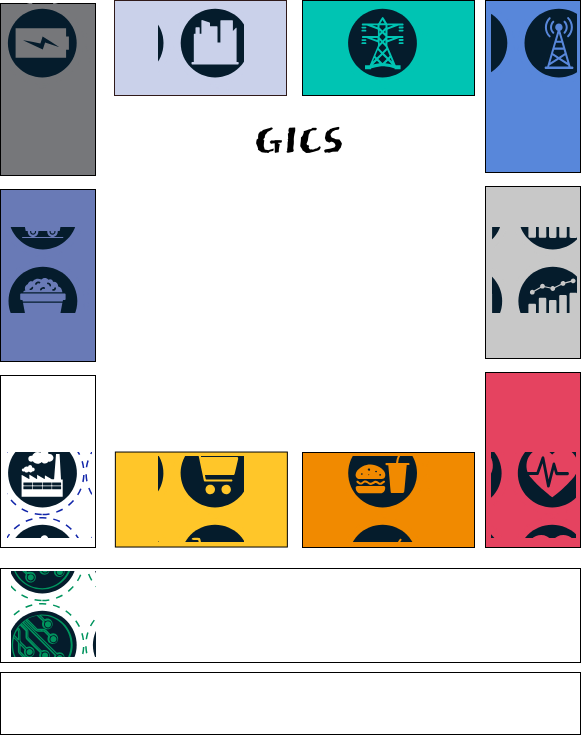
GICS Core
The focus of GICS Core as the TIER 1 level of the G11 General Industry Compass System is on broadly defined economic sectors as stable classification units. Instead of detailed subdivisions, the aim is to classify economic activities into a few viable categories that serve as a long-term frame of reference.
The helicopter perspective of GICS Core opens up space for fundamental questions:
- How do weights shift between sectors?
- What structures shape entire industries across economic cycles?
- And which sectoral dependencies only become visible from a distance?

The Industrials sector brings together companies that enable, organize and implement economic activity. The focus is not on products for end consumption, but on services, systems and services that enable other sectors to operate in the first place. Industrials is therefore an implementation and operating sector. The companies grouped here plan, build, produce, transport, maintain or control - often in the background, but with a direct impact on the efficiency, scaling and stability of economic processes. Without Industrials, value creation remains theory. The sector is characterized by its functional breadth. It ranges from the manufacture of complex machinery and equipment to construction and engineering services through to professional services, logistics and transportation solutions. In addition, there are activities that ensure order, safety and organization - both physically and operationally. What these companies have in common is their operational proximity to the real economy. Projects, investment cycles, capacity utilization, maintenance and reliability play a central role. Decisions are often long-term in nature, highly capital-intensive and closely linked to economic developments, infrastructure requirements and global supply chains. Industrials acts as a link between planning and implementation. The sector translates demand, technological development and social requirements into functioning systems - from production facilities and transportation routes to supporting services in daily operations. Within GICS Eleven, Industrials forms a supporting regulatory framework for numerous specialized topics. It spans the spectrum from classic industry to modern service and infrastructure solutions to highly specialized applications - and thus creates a stable basis for in-depth trend, technology and application perspectives.
GICS Core acts as a strategic thinking space within the General Industry Compass system. The perspective provides orientation without simplifying and creates a common basis on which further perspectives - such as Trending or Microsectors - can be built upon in a targeted manner.
GICS Core is deliberately designed as an introductory and reference level.
The perspective is aimed at users who initially want to get their bearings, grasp interrelationships and understand sectoral structures in a broader economic context without committing to detailed analyses at an early stage.
As an organizing framework, GICS Core is particularly suitable:
- as a conceptual haven of peace within the GICS family,
- as a common reference level for cross-references to in-depth content,
- as well as a conceptual starting point for further perspectives such as GICS Trending or GICS Microsectors.
The level thus serves less for operational analysis and more for strategic classification - it creates an overview, promotes systemic thinking and lays the foundation for in-depth discussion along downstream perspectives.