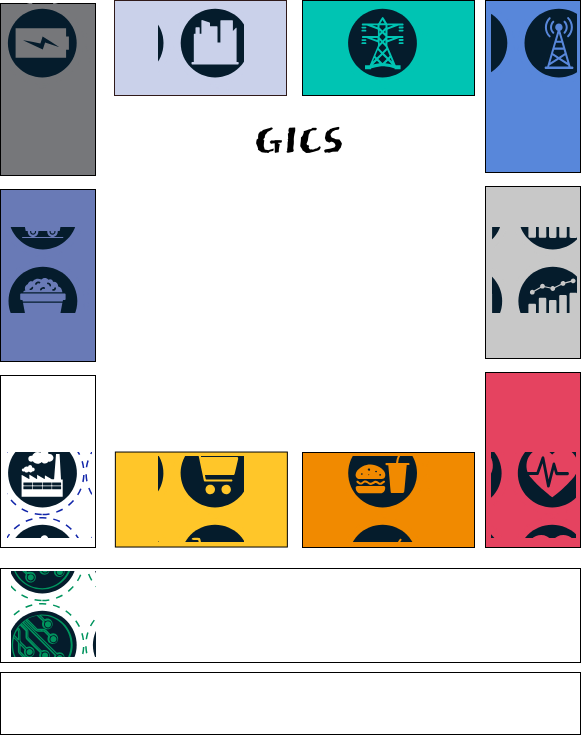
GICS Core
The focus of GICS Core as the TIER 1 level of the G11 General Industry Compass System is on broadly defined economic sectors as stable classification units. Instead of detailed subdivisions, the aim is to classify economic activities into a few viable categories that serve as a long-term frame of reference.
The helicopter perspective of GICS Core opens up space for fundamental questions:
- How do weights shift between sectors?
- What structures shape entire industries across economic cycles?
- And which sectoral dependencies only become visible from a distance?

Within GICS Eleven, the relationship between TIER 1 (CORE), TIER 2 (TREND) and TIER 3 (MICRO) is not conceived as a break, but as a logical continuation within a finely graduated relationship and dependency structure. The tiers build on each other and complement each other instead of functioning separately. TIER 1 (CORE) forms the overarching framework. It serves to structurally classify companies, business models and value chains and provides orientation at a meta-level. TIER 2 (TREND) and TIER 3 (MICRO) start where thematic consolidations, accelerated developments or focused priorities emerge within this framework. Market dynamics and changing information situations can lead to overlaps that make clear categorization difficult or deliberately leave it open. However, this is not a shortcoming, but a conceptual feature. The levels are always related to each other and allow different perspectives on the same market context.
Whether a perspective is perceived as particularly relevant, purely informative or subjectively significant is ultimately at the discretion of the user. GICS Eleven therefore does not see itself as a conclusive authority, but rather as a structured orientation framework. A claim to completeness or interpretative sovereignty is expressly not associated with this
This symbiosis is particularly evident in the example of the Feingold Research information portal. The Materials meta-sector forms the overarching frame of reference: All companies assigned to the sector are fully covered and linked to the relevant news. This creates a complete sectoral sounding board that covers the breadth of the market. At the same time, trend sectors are derived from this core as independent info streams. These no longer follow complete coverage, but rather a focus on content. The range deliberately extends from meta to micro: from Materials as a superordinate sector, to Mining as a functional and operational consolidation, to Rare Earths as a thematically highly specific section within the same value chain. The dividing line is not in the object - some of the companies are the same - but in the perspective.
Tier 1 (Core) answers the question: Where does a company structurally belong?
Tier 2 (Trending) answers the question: Why is a part of this sector currently in focus?
Trend sectors are therefore not created by new classifications, but by thematic weighting, news intensity and market attention. They form dynamic observation areas in which developments emerge earlier and more concentrated than in the broad core.
Like GICS Alpha or GICS IPO, these trend sectors act as curated layers of information: They filter out those segments from the core that are currently characterized by technological, geopolitical or demand-side impulses. This creates direct added value for journalists, editorial teams and analysts: instead of having to sift through the entire meta-sector, the system provides thematically precise information streams that pre-select relevance.
As a result, GICS Eleven thus forms a multidimensional classification system: The core provides structure and completeness, tier 2 for focus and topicality, tier 3 for analytical depth. Trend sectors are not a counter-design to the meta-sector - they are its moving projection.
The Materials sector brings together companies that provide the physical raw materials from which economic activity is created in the first place. The focus is on raw materials, intermediate products and materials that are further processed and are at the beginning of numerous industrial, technological and consumer-related value chains. Materials is not an end market, but a foundation sector. The companies grouped here supply materials that are used in construction, industry, energy, technology, mobility, consumer goods and infrastructure. Their products are rarely visible to end customers, but are found almost everywhere. The Materials sector is characterized by its wide range of content. It ranges from basic, often raw material-related activities to highly specialized materials with clearly defined applications. The areas of application are correspondingly diverse: from structural building materials, metals and minerals to chemical products that are specifically tailored to certain industrial or technological requirements. What the companies in this sector have in common is their close connection to real production processes. Cost structures, energy use, transportation, economies of scale and regulatory framework conditions play a central role. At the same time, global demand cycles, geopolitical factors and technological developments have a direct impact on supply, pricing and investment decisions. Materials therefore plays a connecting role in the economic system. The sector is at the interface between natural resources, industrial processing and downstream industries. Changes in this area often have a time-delayed but profound impact on other sectors. Within GICS Eleven, Materials serves as a stable frame of reference for numerous specialized topics. It forms the content bracket for developments ranging from classic basic materials to highly developed material solutions - and thus creates the basis for further trend, micro and application perspectives.
GICS Core acts as a strategic thinking space within the General Industry Compass system. The perspective provides orientation without simplifying and creates a common basis on which further perspectives - such as Trending or Microsectors - can be built upon in a targeted manner.
GICS Core is deliberately designed as an introductory and reference level.
The perspective is aimed at users who initially want to get their bearings, grasp interrelationships and understand sectoral structures in a broader economic context without committing to detailed analyses at an early stage.
As an organizing framework, GICS Core is particularly suitable:
- as a conceptual haven of peace within the GICS family,
- as a common reference level for cross-references to in-depth content,
- as well as a conceptual starting point for further perspectives such as GICS Trending or GICS Microsectors.
The level thus serves less for operational analysis and more for strategic classification - it creates an overview, promotes systemic thinking and lays the foundation for in-depth discussion along downstream perspectives.